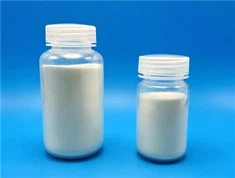
CAS No.:9047-08-9, CM Sephadex C-50
CAS No.:9047-08-9
Synonyms:Carboxymethyl (CM) dextran gel; Sephadex C 50
Description
Technical Parameters
CM Sephadex C-50
CAS No.:9047-08-9
Synonyms
Carboxymethyl Sephadex C-50; Carboxymethyl (CM) dextran gel; Sephadex C 50; Sephadex CM C-50;CAS No.:9047-08-9
dextran backbone group
-O-CH₂-COOH
Specifications
|
ITEMS |
SPECIFICATIONS |
|
Appearance |
White |
|
Loss on Drying |
≤10% |
|
Dry powder particle size distribution range |
40-100µm |
|
Ion exchange type |
Weak Cation |
|
Ion Capacity(mmol/g dry resin) |
4.0~5.0 |
|
Capacity LgG(Mr 160000) Bovine COHb(Mr 69 000) Ribonuclease (Mr 13700) |
7 140 120 |
|
Autoclaving |
In 0. 1M NaCl, 121℃ for 30min (wet gel pH 7.0) |
|
Max Operating Linear Flow |
100 cm/h, 25℃ , hr16/10 column, bed height 5 cm |
|
Working / CIP pH Range |
2~12 |
|
Chemical Stability |
Stable to 8M urea, 6M guanidine hydrochloride and other common aqueous buffers. |
|
Storage Conditions |
Store airtight at room temperature |
Storage
Room Temperature
Package
CAS No.:9041-37-6
100g/bottle,500g/bottle,1000g/bottle
Service
Customized drum/barrel/bottle packaging acceptable.
Application
It is used for the purification of low-molecular-weight proteins, peptides, nucleotides, macromolecules, etc. by means of ion exchange.
FAQ
Q1:What are the differences between CM Sephadex C-25 and CM Sephadex C-50?
A1:
| Property | CM Sephadex C-25 | CM Sephadex C-50 |
| Swelling Degree | Low (approx. 5 g water / g dry resin) | High (approx. 15 g water / g dry resin) |
| Suitable Molecules | Small proteins / peptides (< 30 kDa) | Medium-to-large proteins (30–200 kDa) |
| Bed Volume Variation | Low | High (with changes in pH / ionic strength) |
| Flow Rate | Faster | Slower |
Q2:Application Scenarios of CM Sephadex C-50
A2:
1.Biomacromolecule purification: Separation and purification of antibodies, recombinant proteins, enzymes and peptides; especially suitable for proteins with neutral or alkaline isoelectric points.
2.Bulk processing process: Featuring high binding capacity and good tolerance to high-salt conditions, it is commonly used for bulk adsorption in the primary capture stage.
3.Laboratory chromatography teaching and research: As a classic material for ion exchange chromatography experiments, it is compatible with a variety of buffer systems and elution conditions.
Send Inquiry